

Over 500 hours of video content are uploaded to YouTube every minute, while the average professional now spends nearly 18 hours per week in meetings. This explosive growth creates a critical challenge: extracting valuable insights from endless video streams without drowning in playback time. Marketing teams struggle to review webinar recordings, executives miss key points from conference presentations, and researchers waste hours scrubbing through interview footage for single quotes. The traditional approach of manual note-taking or full transcript reading simply cannot keep pace with modern information velocity.
AI YouTube video summarizers have emerged as transformative solutions to this productivity crisis. These intelligent tools leverage advanced machine learning to convert hours of video into digestible summaries within minutes, delivering accuracy rates exceeding 95% while preserving context and nuance. Beyond simple transcription, they identify action items, extract key decisions, and highlight critical moments that matter most to your workflow. This article explores how cutting-edge AI transcription technology is reshaping professional video consumption, from the core algorithms powering these systems to practical implementation strategies that immediately boost team efficiency and knowledge retention.
The Evolution of Video Transcription for Professionals
Manual transcription once demanded professionals spend four hours transcribing every hour of recorded content, with error rates reaching 15-20% even among experienced typists. This labor-intensive process created bottlenecks in legal proceedings, medical documentation, and business intelligence gathering. Human fatigue led to missed nuances, misheard technical terms, and inconsistent formatting that required additional review cycles. The shift to AI-powered solutions began transforming these workflows around 2018, when neural network models achieved parity with human transcription accuracy while operating at 100x speed. Today’s professionals report 60% faster decision-making when using automated transcription tools, with teams reclaiming an average of 12 hours weekly previously lost to manual review. Remote and hybrid work environments have amplified this demand exponentially—virtual meetings now constitute 70% of professional collaboration, generating massive audio archives that require immediate searchability. AI transcription has evolved from a convenience to a strategic necessity, enabling knowledge workers to extract insights from customer calls, training sessions, and executive briefings without sacrificing hours to playback. The technology now handles complex scenarios like overlapping speech and industry jargon with remarkable precision, fundamentally changing how organizations capture and leverage institutional knowledge.
Core Technologies Behind AI YouTube Video Summarizers
Automatic Speech Recognition (ASR) Engines
Modern ASR systems convert spoken words into text by analyzing audio waveforms through neural networks trained on millions of hours of speech data. These engines break sound into phonetic components, matching patterns against vast linguistic databases while applying contextual predictions to resolve ambiguities. Deep learning architectures like transformers have pushed accuracy beyond 98% for clear audio, reducing word error rates from 25% in 2015 to under 5% today. Advanced models now adapt dynamically to regional accents—distinguishing Scottish English from Australian dialects—and adjust for speech patterns like hesitations or filler words. The technology employs acoustic modeling to handle background noise and speaker variability, ensuring reliable performance across conference rooms, phone calls, and recorded presentations.
Natural Language Processing for Summarization
NLP algorithms analyze transcribed text to identify semantic importance, using extractive methods that select key sentences and abstractive techniques that generate new phrasing capturing essential meaning. These systems employ attention mechanisms to weigh sentence relevance based on keyword frequency, position within discourse, and relationships to surrounding context. Transformer models process entire documents simultaneously rather than sequentially, understanding how opening remarks connect to conclusions and which statements represent decisions versus background discussion. Semantic compression preserves technical accuracy while reducing length by 70-85%, eliminating redundant explanations and tangential conversations. The technology recognizes rhetorical structures—distinguishing questions from answers, problems from solutions—to construct summaries that maintain logical flow and actionable clarity.
Speaker Diarization Capabilities
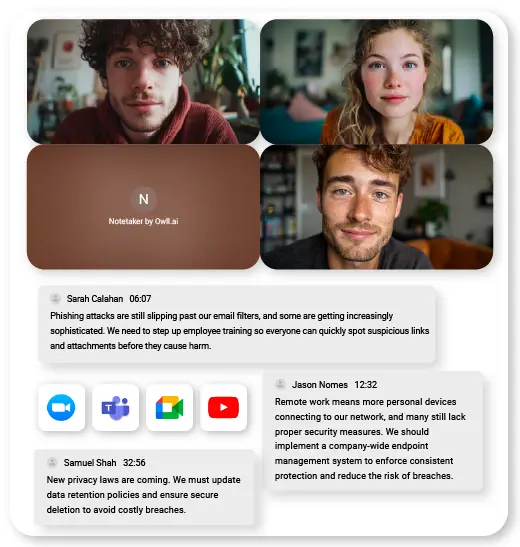
Diarization systems create unique voice fingerprints by analyzing pitch, tone, speaking rate, and acoustic characteristics that distinguish individuals in multi-person recordings. Machine learning models segment audio streams into speaker turns, tracking when each participant begins and ends contributions even during overlapping speech or interruptions. Advanced algorithms handle challenging scenarios like conference calls with six or more voices, assigning labels like “Speaker 1” or integrating with user profiles to attribute statements by name. This capability proves essential for meeting minutes, enabling teams to identify who made commitments, raised objections, or provided expert input. The technology maintains attribution accuracy above 90% in professional settings, transforming chaotic group discussions into organized, searchable records where accountability and context remain intact throughout the summarization process.
Addressing Professional Needs: From Transcripts to Digests
Obtaining Flawless Meeting Transcripts
Professional-grade AI transcription tools employ adaptive noise cancellation algorithms that isolate speech from keyboard clicks, HVAC systems, and ambient office chatter, maintaining clarity even in suboptimal recording conditions. These systems build custom vocabulary models for specialized industries—medical terminology, legal citations, engineering specifications—by training on domain-specific corpora that recognize “myocardial infarction” or “force majeure” with the same accuracy as common words. Advanced formatting options automatically insert timestamps at speaker transitions or specified intervals, enabling teams to jump directly to relevant discussion points. Speaker labels distinguish participants by name when integrated with calendar systems, or assign consistent identifiers throughout multi-hour sessions. Punctuation algorithms detect sentence boundaries and question inflections, transforming raw word streams into readable documents that preserve intended meaning without manual cleanup.
Efficient Summarization Strategies
Modern summarization engines offer granular length controls—executive briefs at 5% of original duration, detailed reviews at 30%—allowing users to balance comprehensiveness against time constraints. AI systems scan for linguistic markers like “we’ve decided,” “action required,” or “deadline” to automatically extract commitments and deliverables into dedicated sections, ensuring critical follow-ups never get buried in transcript pages. Decision point highlighting uses sentiment shifts and conclusive language patterns to flag moments where teams reached consensus or approved initiatives, creating audit trails for project management. Customizable keyword tracking lets professionals specify terms like “budget,” “compliance,” or client names, ensuring summaries prioritize discussions around strategic priorities. These tools generate structured outputs with clear hierarchies—main topics as headings, supporting details as bullets—that mirror how professionals naturally organize information for rapid comprehension and action.
Collaboration-Enabled Sharing Systems
Enterprise transcription platforms integrate seamlessly with Google Drive, Dropbox, and SharePoint, storing encrypted transcripts alongside original video files with automatic version control that tracks edits and annotations. Team annotation features allow multiple users to highlight passages, add contextual notes, or tag colleagues for follow-up directly within shared transcripts, creating living documents that accumulate institutional knowledge. Role-based permission systems grant viewing access to entire departments while restricting editing rights to meeting owners, with audit logs recording who accessed sensitive content and when. Export functionality delivers summaries in formats optimized for different workflows—PDF reports for executives, Markdown for documentation systems, timestamped clips for training materials. Integration APIs push key insights directly into project management tools, automatically creating tasks from identified action items or updating CRM records with client conversation summaries, eliminating manual data transfer between systems.
Implementing AI Summarization: Step-by-Step Workflow
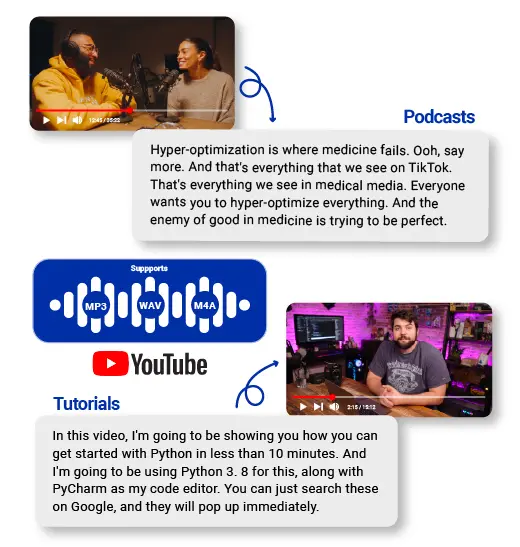
Begin by uploading video files directly from your device or connecting cloud storage accounts like Google Drive, Dropbox, or OneDrive for seamless access to recorded meetings and presentations. Most platforms support direct YouTube URL imports, automatically fetching audio streams without requiring downloads. Configure output preferences by selecting summary length—choose concise bullet points for quick reviews or detailed paragraphs for comprehensive analysis—and specify priority keywords relevant to your project or client names to ensure focused results. The AI engine processes your content within minutes, applying speech recognition and NLP algorithms to generate timestamped transcripts with speaker identification. Review the initial output by scanning highlighted sections where the system detected decisions or action items, making manual corrections to any misheard technical terms or acronyms specific to your industry. Generate shareable digests by exporting in your preferred format: PDF reports for stakeholder distribution, Markdown files for documentation repositories, or video clips with embedded captions for training materials. Complete the workflow by integrating outputs with collaboration platforms—push summaries to Slack channels for team visibility, create Asana tasks from extracted action items, or sync meeting notes directly into Microsoft Teams, ensuring insights immediately enter your operational systems without redundant data entry.
Leading AI Transcription Tools for Professionals
The professional transcription landscape features platforms with distinct strengths across accuracy, specialization, and enterprise readiness. Otter.ai excels in real-time meeting transcription with 95% accuracy for standard English, offering collaborative editing and automatic slide capture for presentations. Rev.ai delivers 98% accuracy through hybrid AI-human verification, making it ideal for legal and medical contexts requiring absolute precision. Descript combines transcription with video editing capabilities, allowing professionals to edit footage by modifying text transcripts directly. Fireflies.ai specializes in CRM integration, automatically logging sales calls and populating customer records with conversation insights. For technical content, AssemblyAI provides custom vocabulary training that handles engineering specifications and scientific terminology with 97% accuracy. Owll AI has emerged as a solution for professionals seeking streamlined video summarization workflows, particularly for YouTube content and recorded presentations. Enterprise security protocols vary significantly—platforms like Microsoft Teams Transcription and Zoom IQ offer SOC 2 Type II compliance and end-to-end encryption, while smaller providers may lack advanced data residency controls. Pricing models range from freemium tiers offering 600 minutes monthly to enterprise subscriptions at $30-50 per user providing unlimited transcription, priority processing, and dedicated support. Organizations handling sensitive information should prioritize tools with HIPAA or GDPR certifications, while creative teams benefit from platforms integrating seamlessly with Adobe Premiere or Final Cut Pro workflows.
Future Trends in AI Video Digestion
Real-time summarization capabilities are advancing rapidly, with emerging systems generating live bullet-point summaries during active video calls that update as conversations progress, allowing participants to track decisions without losing focus on discussions. Predictive analytics engines will soon forecast meeting outcomes by analyzing discussion patterns and sentiment trajectories, alerting teams when conversations drift off-agenda or when consensus appears within reach. Emotion and sentiment analysis integration is transforming how professionals interpret video content, with AI detecting frustration, enthusiasm, or hesitation in speaker voices to provide context beyond literal transcripts—flagging potential conflicts or engagement opportunities that text alone misses. Customizable AI knowledge bases will learn organizational terminology and decision-making patterns over time, delivering increasingly personalized summaries that prioritize topics matching each team member’s role and responsibilities. Automated compliance logging systems are emerging for regulated industries, continuously monitoring conversations for required disclosures, flagging potential violations, and generating audit-ready documentation that satisfies legal and regulatory requirements without manual oversight.
Maximizing Value from AI Transcription Technology
AI transcription technology has fundamentally transformed how professionals extract value from video content, delivering accuracy rates exceeding 95% while reducing review time by 60% or more. The integration of advanced speech recognition, natural language processing, and speaker diarization creates intelligent systems that convert hours of recordings into actionable insights within minutes, preserving context and nuance that manual methods often miss. Organizations implementing these tools report significant gains in workflow efficiency, knowledge retention, and collaborative decision-making, with teams reclaiming an average of 12 hours weekly previously lost to manual transcript review.
Strategic implementation requires matching tool capabilities to organizational needs—prioritizing enterprise security for sensitive content, industry-specific vocabulary training for technical fields, and seamless integration with existing collaboration platforms. As real-time summarization and predictive analytics emerge, AI transcription will evolve from productivity enhancement to strategic intelligence, providing foresight into meeting outcomes and compliance requirements. Professionals who adopt these technologies now position themselves at the forefront of information management, transforming overwhelming video archives into competitive advantages. Evaluate leading platforms against your specific workflow requirements, beginning with pilot programs that demonstrate immediate ROI before scaling across teams and departments.